
Intersections are among the most dangerous places on American roads for motorcycle riders. Multiple vehicles approach from different directions, traffic signals change within seconds, pedestrians may be crossing, and drivers must constantly judge the speed and position of surrounding traffic. For motorcyclists, even a small mistake by another road user can result in a serious collision because riders have significantly less physical protection than people inside passenger vehicles.
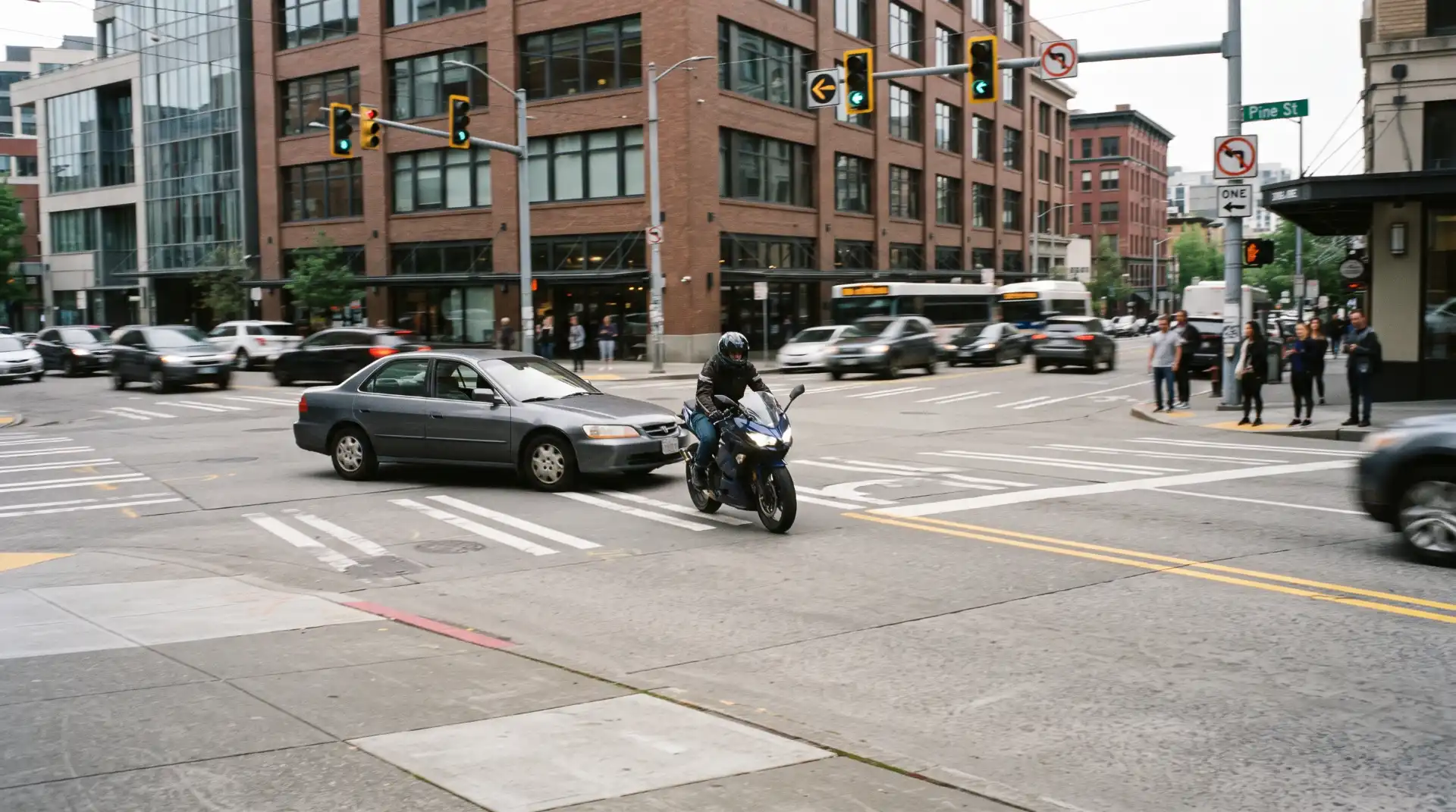
One of the most common and dangerous intersection situations occurs when a vehicle traveling in the opposite direction turns left directly across the path of an approaching motorcycle. These crashes can happen when a driver fails to see the rider, misjudges the motorcycle’s speed or distance, becomes distracted, or assumes there is enough time to complete the turn. The motorcycle may be traveling straight through the intersection with the right of way, yet the rider can still have only seconds to recognize the threat and respond.
The National Highway Traffic Safety Administration emphasizes that motorists need to understand the visibility challenges associated with motorcycles and encourages drivers and riders to share the road responsibly. NHTSA reports that 6,228 motorcyclists were killed in traffic crashes in the United States in 2024, demonstrating the continuing importance of motorcycle safety and motorist awareness. You can review the agency’s current motorcycle safety information for additional federal guidance.
Why Left-Turning Vehicles Create a Serious Motorcycle Crash Risk
A left-turn collision often develops in a relatively simple sequence. A motorcycle approaches an intersection while traveling straight. At the same time, a vehicle traveling in the opposite direction waits to turn left. The driver checks traffic, decides to proceed, and begins crossing the motorcycle’s lane. If the driver has not properly identified the motorcycle or has incorrectly judged its distance, the two vehicles can reach the same point at nearly the same time.
For the rider, the danger is that the turning vehicle may appear to move suddenly into the motorcycle’s path. A motorcyclist may have very little room to brake or swerve. Even when the rider immediately recognizes the danger, the available stopping distance may not be enough to avoid impact.
The situation can be particularly dangerous on wide roads where traffic moves at higher speeds. A driver may see a motorcycle approaching but believe the motorcycle is farther away than it actually is. Because motorcycles occupy less visual space than passenger vehicles, estimating their speed and distance can sometimes be more difficult.
This does not mean that motorcycle riders are responsible for these crashes simply because motorcycles can be harder to see. Drivers have an obligation to observe traffic and make safe turning decisions. The circumstances of each collision must be evaluated individually to determine how the crash occurred and whether a driver’s actions contributed to the injuries.
Why Drivers Sometimes Fail to See Motorcycles
Motorcycle visibility is a major safety issue at intersections. A motorcycle is considerably smaller than a pickup truck, SUV, or passenger car. When several vehicles are approaching an intersection, a motorcycle can occupy only a small portion of a driver’s field of vision.
A driver may look toward oncoming traffic without fully recognizing that a motorcycle is approaching. This can happen because the rider is partially obscured by another vehicle, because the motorcycle blends into the surrounding environment, or because the driver’s attention is focused on another part of the intersection.
Motorcycles can also disappear temporarily behind larger vehicles. For example, a driver waiting to make a left turn may see an approaching SUV and assume that there are no other vehicles immediately behind it. If a motorcycle is traveling behind the SUV, the larger vehicle can temporarily block the rider from view. Once the SUV passes, the motorcycle may suddenly become visible, leaving the driver with little time to react.
NHTSA specifically identifies motorcycle size and visibility as important challenges for motorists. The agency also advises drivers to be particularly cautious around intersections and reminds riders to take steps to make themselves more visible.
Speed and Distance Misjudgment Can Lead to Left-Turn Crashes
Another common issue involves judging how quickly a motorcycle is approaching. Drivers may underestimate a motorcycle’s speed or overestimate the amount of time available to complete a turn.
Imagine a driver waiting at an intersection and seeing a motorcycle several hundred feet away. The driver may believe the motorcycle is far enough away to allow a left turn. However, if the rider is traveling at highway or arterial-road speeds, the motorcycle can cover that distance much faster than the driver expects.
Once the vehicle begins turning, the rider may suddenly face an obstacle directly in the travel path. Braking distance becomes especially important at that point. If the motorcycle is already close to the intersection, the rider may not have enough room to stop completely.
Motorcyclists should therefore remain attentive even when they have a green traffic signal. Having the right of way does not guarantee that every approaching driver will recognize or respect it. Watching the wheels and movement of vehicles waiting to turn can sometimes provide an early warning that a driver is preparing to enter the rider’s path.
Distracted Driving Makes Intersection Motorcycle Crashes More Dangerous
Distraction can turn an already complicated intersection into an extremely dangerous environment. Drivers may be looking at phones, navigation systems, dashboard screens, passengers, food, or other objects rather than continuously monitoring traffic.
A driver who looks down at a phone for only a few seconds can miss an approaching motorcycle. When the driver looks back toward the roadway, the motorcycle may already be much closer than expected.
This is particularly dangerous during left turns because the driver needs to continuously monitor opposing traffic before and during the maneuver. A momentary loss of attention can prevent the driver from noticing a motorcycle until it is too late.
For readers interested in the relationship between distraction and motorcycle collisions, the site’s article How Distracted Driving Increases Motorcycle Accident Risk in 2026 provides additional information about phone use, blind spots, evidence, insurance disputes, and distracted-driving claims.
Evidence of distraction can become important after a crash. Depending on the circumstances, investigators may examine witness statements, traffic-camera footage, business surveillance video, police reports, phone records, vehicle data, and other evidence.
Why Left-Turn Motorcycle Crashes Can Cause Severe Injuries
The physical consequences of a motorcycle collision can be substantially different from those of a typical passenger-vehicle crash. A person inside a car is surrounded by a passenger compartment designed to provide protection during certain types of collisions. A motorcycle rider has no comparable enclosed structure.
When a vehicle turns directly into a motorcycle, the rider may collide with the side of the vehicle and then be thrown onto the roadway. The rider may also slide across pavement, strike another vehicle, collide with a fixed object, or suffer additional impacts after being separated from the motorcycle.
Potential injuries include broken bones, shoulder injuries, knee injuries, road rash, spinal injuries, traumatic brain injuries, internal injuries, and damage to muscles or connective tissue. Some injuries can require months of rehabilitation and may interfere with work, family responsibilities, transportation, and everyday activities.
The severity of an injury cannot always be determined immediately after a collision. Adrenaline can temporarily mask pain, while certain injuries may take hours or longer to become apparent. Anyone involved in a serious motorcycle crash should seek appropriate medical attention and follow medical recommendations.
Intersection Design Can Affect Motorcycle Crash Risk
Not every intersection presents the same risks. Road design can influence visibility, traffic speed, turning patterns, stopping distances, and the amount of time drivers have to recognize motorcycles.
Wide intersections with multiple lanes can create complicated sight lines. A driver may have to monitor several lanes of oncoming traffic while simultaneously watching pedestrians, traffic signals, bicycles, and other vehicles.
Some intersections also have dedicated left-turn lanes and protected or permitted turn phases. Others allow vehicles to turn left across opposing traffic when there is a sufficient opening.
Lighting can also make a difference. Intersections that are difficult to see at night may create additional challenges for both drivers and riders. Glare from headlights or the setting sun can temporarily reduce visibility, while rain can reflect artificial lighting and make roadway markings more difficult to interpret.
Road construction can introduce another layer of complexity. Temporary lane markings, cones, barriers, changing traffic patterns, and construction equipment can make an intersection unfamiliar even to people who regularly drive through the area.
Traffic Signals Do Not Eliminate Motorcycle Crash Risks
A green light gives a motorcyclist permission to proceed when it is safe to do so, but it does not guarantee that opposing drivers will behave correctly. Drivers can run red lights, turn against signals, fail to yield, misunderstand traffic-control devices, or simply overlook a motorcycle.
That is why experienced riders often scan intersections before entering them. Looking beyond the traffic signal and observing vehicles waiting to turn can help a rider recognize potential hazards earlier.
For example, if an oncoming vehicle is positioned at an angle and appears ready to turn left, the rider may recognize the possibility of a conflict. If the vehicle’s wheels begin moving, that can provide another warning that the driver may enter the motorcycle’s path.
Defensive riding does not transfer responsibility for a crash to the motorcyclist. Instead, it is a safety strategy designed to provide additional awareness when other road users make unexpected decisions.
Evidence That May Help Explain an Intersection Motorcycle Crash
Determining what happened after an intersection crash can require more than the statements of the drivers involved. Each person may remember the collision differently, particularly when the impact happened within a few seconds.
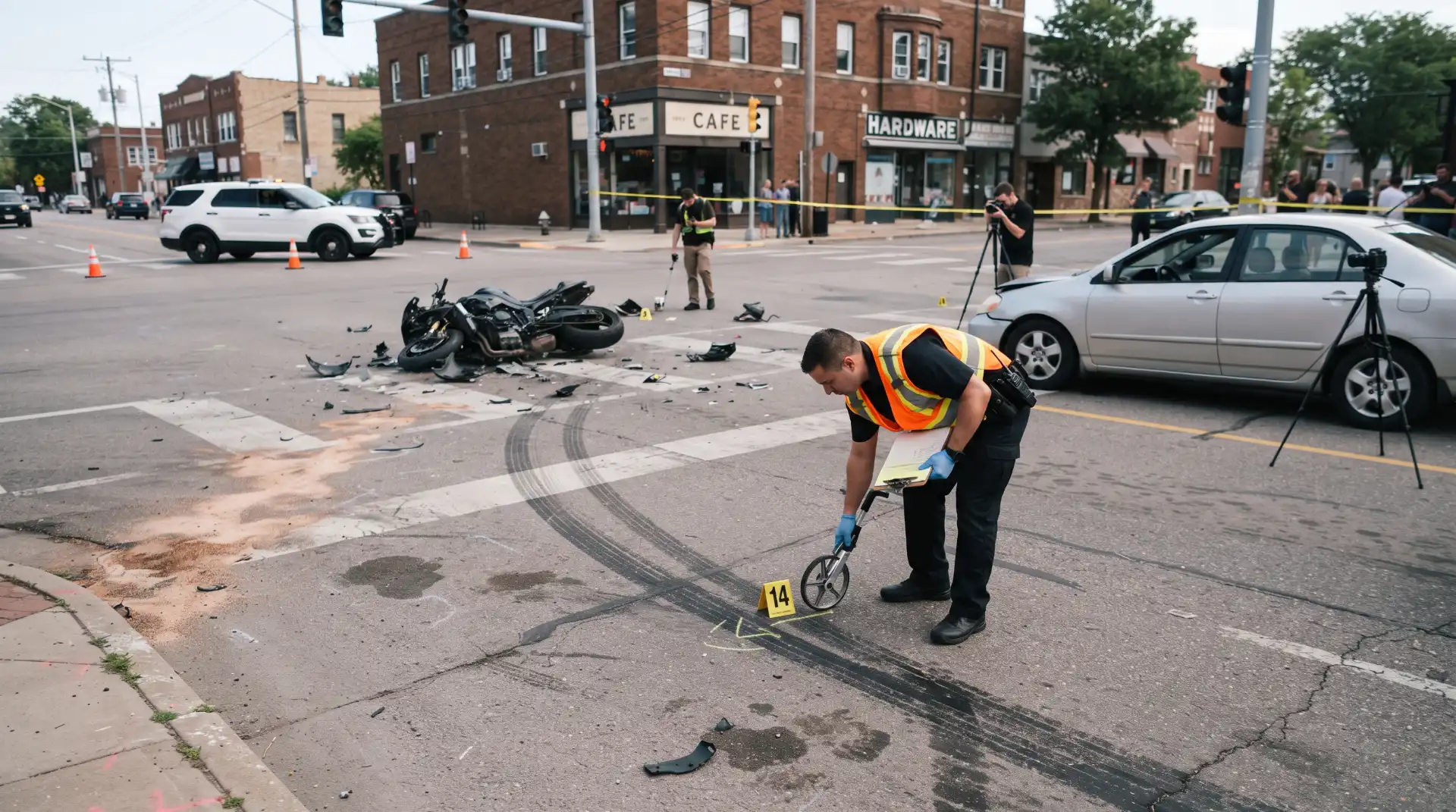
Physical evidence, video recordings, witness statements, vehicle damage, traffic signals, roadway markings, and electronic information can help establish a more complete picture.
Police Reports
A police report may contain information about the drivers, witnesses, road conditions, traffic controls, vehicle positions, injuries, and observations made by responding officers. The report can be an important source of information, although the facts and conclusions should still be reviewed in light of all available evidence.
Traffic and Security Cameras
Video can be especially valuable in intersection cases. Traffic cameras may capture vehicle movements, traffic signals, and the moments immediately before impact. Nearby businesses may also have exterior cameras that happen to record the roadway.
Video retention periods vary. Some systems overwrite recordings after a relatively short period. For that reason, identifying potentially relevant video quickly can be important.
Witness Statements
People standing near an intersection may see details that the drivers do not. A witness might observe a vehicle accelerating through a turn, a motorcycle traveling through a green light, or a driver looking away from the roadway before turning.
Witness information can become more difficult to locate as time passes, so preserving contact information can be useful after a serious collision.
Vehicle Damage
The location and pattern of damage can help accident investigators understand the angle of impact and the movement of the vehicles. Damage to the front of a motorcycle combined with damage to the side of a passenger vehicle may be consistent with a turning-vehicle collision, although the specific evidence must be examined in context.
Roadway Evidence
Skid marks, tire marks, debris, damaged signs, vehicle fluids, and final resting positions can also provide information. Investigators may photograph and measure the roadway to help reconstruct the sequence of events.
How Advanced Driver-Assistance Technology May Affect Intersection Crashes
Modern vehicles increasingly use cameras, radar, automatic emergency braking, blind-spot monitoring, lane assistance, and other driver-assistance systems. These technologies are designed to help drivers identify potential hazards, but they do not eliminate the need for human attention.
Motorcycle detection can be particularly challenging because motorcycles have a smaller profile than passenger vehicles. The technology must identify the motorcycle, determine its position, estimate its movement, and determine whether it represents an imminent collision threat.
The site’s article Can Automatic Emergency Braking Detect Motorcycles Before a Crash? examines this issue in greater detail, including motorcycle detection, camera and radar systems, nighttime conditions, motorcycle positioning, and the limitations of automatic emergency braking.
Intersection crashes can be especially complicated for automated systems because a motorcycle may be approaching from the opposite direction while another vehicle is turning across its path. This is different from a straightforward rear-end collision where the motorcycle is directly in front of the vehicle.
As technology continues developing, crash investigations may increasingly involve electronic vehicle information in addition to traditional physical evidence.
Autonomous and Semi-Autonomous Vehicles Create Additional Questions
Some newer vehicles include increasingly sophisticated driving assistance features. These systems can influence steering, braking, lane positioning, or speed under specific conditions.
When a motorcycle collision involves a vehicle equipped with advanced automation, investigators may need to determine what system was active, what the system detected, whether warnings were issued, whether the driver was expected to supervise the vehicle, and what the driver did immediately before the collision.
The site’s article Motorcycle Accidents Involving Autonomous Vehicles discusses how autonomous and semi-autonomous systems can create additional questions involving left turns, lane changes, blind spots, sensor performance, and electronic vehicle data.
The presence of technology does not automatically establish that a system failed or that a manufacturer is responsible for a crash. Liability depends on the facts, applicable law, evidence, and circumstances surrounding the collision.
Comparative Fault May Become an Issue After a Motorcycle Crash
After a motorcycle accident, an insurance company may investigate whether the rider contributed to the collision. The insurer might allege that the motorcycle was traveling too fast, that the rider was difficult to see, or that the rider could have taken additional evasive action.
Whether such arguments are supported by evidence is a separate question. A rider should not assume that an insurance company’s position accurately describes what happened.
Comparative-fault rules also vary between states. Some states reduce compensation based on a person’s percentage of responsibility, while other states use different approaches. The specific law applicable to a motorcycle accident depends on where the crash occurred and the circumstances of the case.
This is one reason evidence is so important. Video, witnesses, physical evidence, traffic signals, photographs, medical records, and accident-reconstruction analysis can help establish what each person did before the collision.
What Should a Motorcyclist Do Immediately After an Intersection Crash?
The first priority after a serious motorcycle crash is safety and medical care. If emergency assistance is needed, calling 911 should take priority over collecting evidence.
Once the scene is safe and medical needs are being addressed, photographs can help preserve information about the crash. Images may include the motorcycle, other vehicles, roadway markings, traffic signals, debris, skid marks, visible injuries, weather conditions, and the surrounding intersection.
Motorcyclists should also obtain witness contact information when possible. The names and contact details of people who observed the crash may become valuable later if the drivers provide conflicting accounts.
The motorcycle itself should also be preserved. Damage may provide important information about the collision. Riders should be cautious about authorizing repairs before photographs, inspections, insurance documentation, or other necessary evidence has been preserved.
Medical documentation should also be maintained. Emergency-room records, physician notes, imaging results, prescriptions, physical therapy records, and other treatment documentation can help establish the nature and duration of accident-related injuries.
Why Medical Documentation Matters After an Intersection Crash
A motorcycle accident can produce both immediate and delayed symptoms. A rider may initially focus on a visible injury while failing to recognize other problems.
For example, a person with a broken arm may also have neck pain, headaches, back pain, or symptoms associated with a concussion. A medical professional can evaluate those symptoms and determine whether additional testing or treatment is appropriate.
Medical records can also establish the progression of an injury. They may document when symptoms began, what treatment was provided, whether the person required rehabilitation, and whether doctors recommended additional care.
For an injury claim, this documentation can become important because the consequences of a crash are not always limited to the initial emergency-room visit.
Insurance Companies May Investigate the Crash Differently
After an intersection motorcycle accident, one or more insurance companies may become involved. The motorcycle rider may communicate with their own insurer, while the other driver’s insurer may investigate liability and potential damages.
An insurance adjuster may ask questions about the collision, injuries, treatment, motorcycle damage, employment, or other circumstances.
Insurance companies have a legitimate interest in investigating claims, but an injured rider should still be careful about making assumptions or giving statements without understanding the potential implications. The facts of a motorcycle crash can be complicated, particularly when liability is disputed.
The Motorcycle Accident Resources section on this website provides additional information concerning motorcycle accident claims, insurance disputes, catastrophic injuries, uninsured and underinsured motorists, intersection accidents, and other legal issues.
Potential Damages After a Serious Motorcycle Intersection Crash
When another person’s negligence causes a motorcycle collision, an injured rider may potentially face a wide range of financial and personal consequences. The specific damages available depend on the facts of the case and the law of the state where the accident occurred.
Medical expenses may include emergency treatment, hospital care, surgery, medications, diagnostic testing, rehabilitation, physical therapy, and future medical care. Serious injuries can also require modifications to a home or vehicle, assistive equipment, or long-term treatment.
Lost income can become another significant issue. A rider who cannot work because of injuries may lose wages during recovery. Some serious injuries can affect a person’s ability to return to the same job or earn the same income in the future.
Property damage can include motorcycle repairs or replacement, damaged safety equipment, and other personal property damaged in the collision.
Depending on state law and the circumstances, an injured person may also seek compensation for non-economic losses such as pain, emotional distress, inconvenience, and reduced quality of life.
Why State Law Matters in Motorcycle Accident Claims
Motorcycle accident law is not identical throughout the United States. Each state can have its own rules concerning fault, insurance, helmets, lane splitting, filing deadlines, damages, and other aspects of an injury claim.
For example, a legal rule that applies to a motorcycle accident in California may not apply to an accident in Florida, Texas, Arizona, New York, or another state.
The location of the crash therefore matters when evaluating an injury claim. Riders should avoid assuming that general online information applies automatically to their specific accident.
State-specific legal advice can help determine which rules apply, what deadlines may exist, and what evidence may be important.
Defensive Riding Can Help Riders Recognize Intersection Dangers
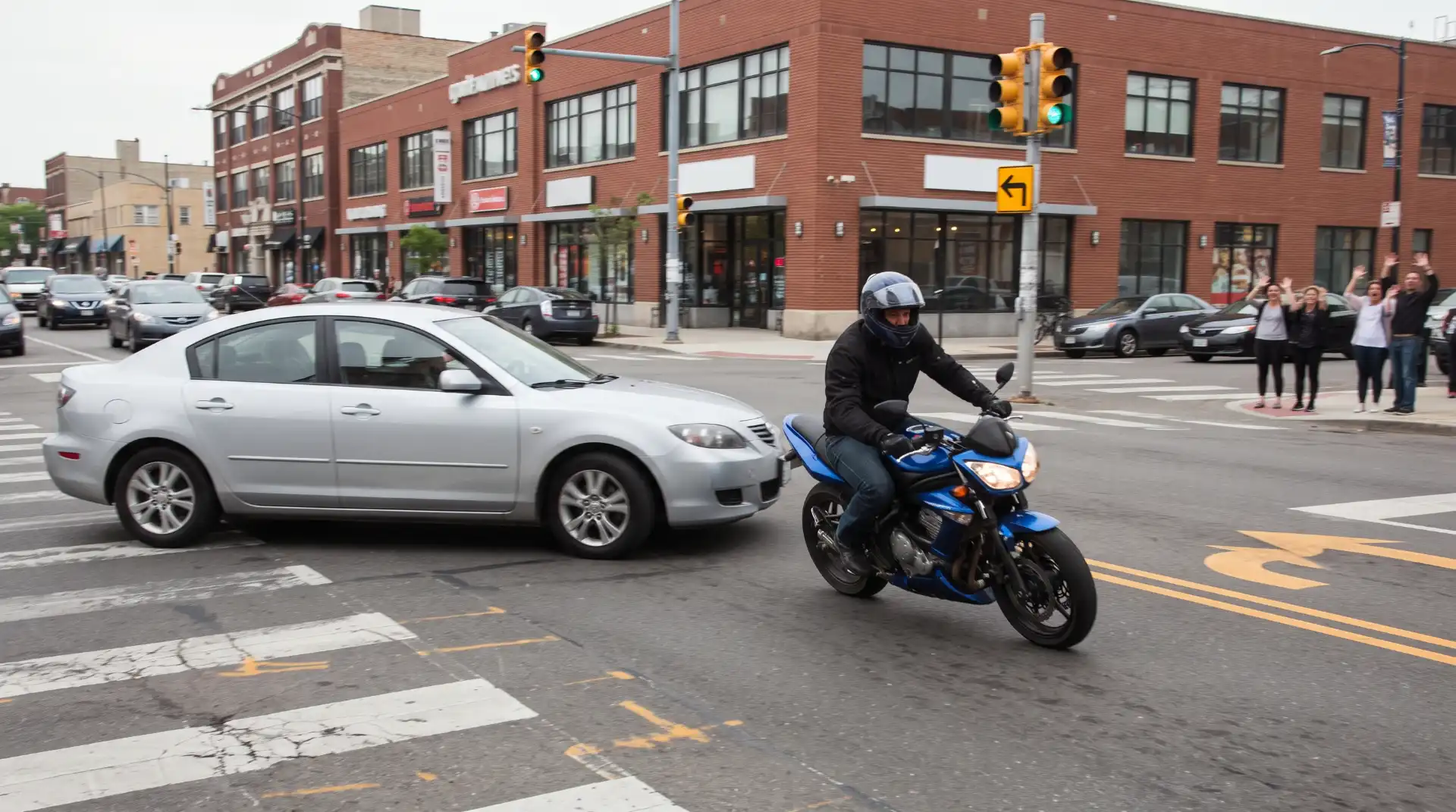
Motorcyclists cannot control whether another driver will pay attention, but defensive riding can help riders identify potentially dangerous situations sooner.
Approaching an intersection requires more than watching the traffic signal. Riders can scan for vehicles waiting to turn, vehicles approaching at excessive speed, pedestrians, changing traffic patterns, and other hazards.
Maintaining an appropriate amount of space can provide additional time to react. Riders can also remain aware of escape routes when traffic conditions permit.
Visibility remains important. Working headlights, brake lights, and turn signals can help other road users recognize the motorcycle. Reflective or highly visible riding equipment may also help increase visibility.
NHTSA recommends defensive riding and specifically advises motorcyclists to proceed cautiously at intersections. The agency also recommends obeying traffic lights, signs, speed limits, and lane markings while maintaining sufficient space around other vehicles. Read NHTSA’s motorcycle safety guidance for additional information.
Nighttime Intersections Require Additional Awareness
Nighttime conditions can make motorcycle visibility even more challenging. A driver may have less time to recognize a motorcycle against a dark background, while glare from headlights and streetlights can affect visual perception.
Wet pavement can further complicate visibility by reflecting headlights and traffic signals. Rain can also reduce the clarity of roadway markings and make it more difficult for both drivers and riders to judge distance.
Motorcyclists should use appropriate lighting equipment and remain especially attentive when approaching intersections at night. Drivers should likewise slow down when conditions reduce visibility and should carefully scan for motorcycles before turning.
Road Construction Can Increase Intersection Risks
Temporary construction zones can create unusual intersection conditions. Traffic lanes may shift, signals may be temporary, and familiar road layouts may change.
A motorcycle rider who normally knows an intersection may encounter an entirely different traffic pattern because of construction. Drivers may also become confused by cones, temporary signs, flaggers, barriers, and lane closures.
When road construction is present, both motorcycles and larger vehicles need additional time and space. Sudden lane changes and unexpected turns can increase the risk of a collision.
What Happens When the Driver Leaves the Scene?
Some intersection motorcycle crashes become even more complicated when the driver leaves without stopping.
A hit-and-run can make it difficult to identify the responsible vehicle and obtain insurance information. In those situations, witnesses, surveillance footage, traffic cameras, helmet cameras, vehicle fragments, and other evidence may become particularly important.
Even if the driver cannot immediately be identified, the rider should report the crash and seek medical attention. Depending on the circumstances and applicable insurance coverage, uninsured or underinsured motorist coverage may also become relevant.
The evidence available in the first hours and days after a crash can sometimes be critical, particularly when video footage may be overwritten or witnesses become difficult to locate.
When an Attorney May Help After a Motorcycle Intersection Accident
Not every motorcycle crash requires an attorney. A relatively minor collision with clear liability and limited injuries may sometimes be handled through an insurance claim.
However, legal assistance may become particularly important when the rider suffers serious injuries, liability is disputed, multiple vehicles are involved, an insurance company denies or undervalues the claim, the driver was allegedly distracted or impaired, or the crash involves complicated technology or other evidence.
An attorney may investigate the collision, identify potentially responsible parties, preserve evidence, communicate with insurance companies, review medical documentation, and evaluate potential damages.
In more complicated cases, an attorney may also work with accident reconstruction professionals or other specialists to analyze vehicle positions, roadway evidence, video footage, electronic data, and other information.
The appropriate approach depends on the facts of the individual collision and the laws of the jurisdiction where the accident occurred.
How Accident Reconstruction Can Help Explain a Left-Turn Collision
Accident reconstruction may be useful when the drivers provide different accounts of the collision or when the physical evidence is complicated.
A reconstruction specialist may examine vehicle damage, motorcycle damage, photographs, skid marks, roadway measurements, traffic signals, surveillance footage, vehicle positions, and other information.
The objective is to determine how the collision likely occurred based on available evidence. The analysis can help establish vehicle direction, approximate movements, points of impact, and other characteristics of the crash.
In serious injury cases, this type of evidence may help clarify disputes about whether a driver had sufficient opportunity to see the motorcycle or whether the motorcycle was already too close for the driver to safely complete the turn.
Intersection Motorcycle Crashes Are Often Preventable
Many intersection motorcycle collisions develop because a driver fails to recognize an approaching rider or makes an unsafe decision while turning.
Some crashes involve distraction. Others involve speed misjudgment, poor visibility, blocked sight lines, unfamiliar road layouts, or failure to yield.
Technology may help reduce certain risks, but automated systems cannot replace careful driving. Motorists must continue monitoring traffic even when their vehicles are equipped with advanced safety features.
Motorcyclists also benefit from defensive awareness. Riders who recognize the warning signs of a potential left-turn collision may have more time to respond to an unexpected vehicle movement.
Final Thoughts on Motorcycle Accidents at Intersections
Motorcycle accidents at intersections can occur in a matter of seconds, but the consequences can affect an injured rider for months or years. Left-turning vehicles are particularly dangerous because they can cross directly into the path of an approaching motorcycle, leaving the rider with limited time and space to avoid the collision.
Drivers may fail to see motorcycles because of their smaller size, blocked sight lines, distractions, poor visibility, or incorrect assumptions about speed and distance. These factors can combine to create a serious crash even when a motorcyclist is traveling lawfully through an intersection.
For injured riders, understanding what happened is an important part of protecting a potential claim. Police reports, photographs, video recordings, witness statements, vehicle damage, motorcycle damage, roadway evidence, medical records, and electronic vehicle information can all contribute to the investigation.
Advanced driver-assistance technology is also becoming increasingly relevant. Automatic emergency braking, cameras, radar, blind-spot monitoring, and other systems may provide additional safety benefits, but motorcycles can still present unique detection challenges. When a crash involves an automated or semi-automated vehicle, additional electronic evidence may need to be examined.
The legal consequences of an intersection motorcycle crash depend on the specific circumstances and the law of the state where the collision occurred. Comparative-fault rules, insurance requirements, filing deadlines, helmet laws, and available damages can vary throughout the United States.
For that reason, injured motorcyclists should focus first on obtaining appropriate medical care, documenting the collision, preserving available evidence, and learning how the applicable state law may affect their situation.
Most importantly, motorcycle safety at intersections requires attention from everyone sharing the roadway. Drivers should actively look for motorcycles before turning, while riders should remain alert for vehicles that may unexpectedly enter their path. Better awareness from both groups can help prevent dangerous intersection crashes and reduce the devastating injuries that can follow when a motorcycle and passenger vehicle collide.
Important: This article provides general educational information about motorcycle accidents in the United States and is not legal advice. Motorcycle accident laws vary by state, and the facts of each collision are different. Anyone involved in a serious motorcycle accident should consider speaking with a qualified attorney in the applicable jurisdiction about their individual circumstances.
Additional Motorcycle Accident Resources
For more information about motorcycle accident claims, insurance disputes, catastrophic injuries, intersection accidents, uninsured and underinsured motorists, and other motorcycle-related legal topics, visit the Motorcycle Accident Resources section of this website.