
Automatic emergency braking can detect motorcycles in many situations, but detection is not equally reliable across every vehicle or driving condition. Modern systems use cameras, radar, or both to identify hazards ahead. Research shows that these systems can reduce crashes involving motorcycles, although their performance may remain weaker than their performance around passenger cars.
For motorcyclists, that difference matters. A motorcycle presents a much smaller visual and radar target than an SUV, pickup truck, or passenger car. Lighting, road position, weather, speed, curves, and the motorcycle’s orientation can also affect whether a vehicle recognizes a rider early enough to brake.
As automatic emergency braking becomes more common across the United States, understanding its strengths and limitations can help riders and drivers better understand what this technology actually does.
What Is Automatic Emergency Braking?
Automatic emergency braking, commonly called AEB, is an advanced driver assistance feature designed to respond when a vehicle detects an imminent frontal collision.
The system continuously monitors the road ahead through sensors. Depending on the vehicle, these sensors may include forward-facing cameras, radar units, or a combination of technologies.
If the system determines that the vehicle is rapidly approaching another road user or object, it may first issue a forward collision warning. If the driver does not respond quickly enough, AEB may automatically apply the brakes.
The goal is not always to stop the vehicle completely. In some situations, the system may only reduce speed before impact. Even a reduction in impact speed can affect crash severity.
The National Highway Traffic Safety Administration explains that collision-imminent braking can automatically apply the brakes when a driver does not react to a detected crash threat.
Can AEB Systems Recognize a Motorcycle?
Yes, some automatic emergency braking systems can recognize motorcycles.
However, the answer becomes more complicated when considering every system and every possible crash scenario.
AEB technology has traditionally been developed around common vehicle-to-vehicle rear-end crashes. Detecting another passenger car directly ahead presents a relatively large and predictable target.
A motorcycle is different. Its narrow profile occupies much less space within a camera image. It can also produce a smaller radar signature.
Motorcycles may ride near the center of a lane, closer to one side, or temporarily move within the lane to maintain visibility and avoid hazards. These normal riding patterns can create additional challenges for systems designed around larger vehicles.
Research from the Insurance Institute for Highway Safety provides encouraging evidence that front crash prevention technology can reduce crashes involving motorcycles. However, researchers have also identified a performance gap.
An IIHS-supported study involving more than 160,000 two-vehicle rear-end crashes found that front crash prevention systems were associated with a 41 percent reduction in rear-end crashes where the struck vehicle was a motorcycle. The reduction was 53 percent when the struck vehicle was another passenger vehicle.
That difference suggests that motorcycle detection has improved while leaving room for further development.
How Does Automatic Emergency Braking Detect Motorcycles?
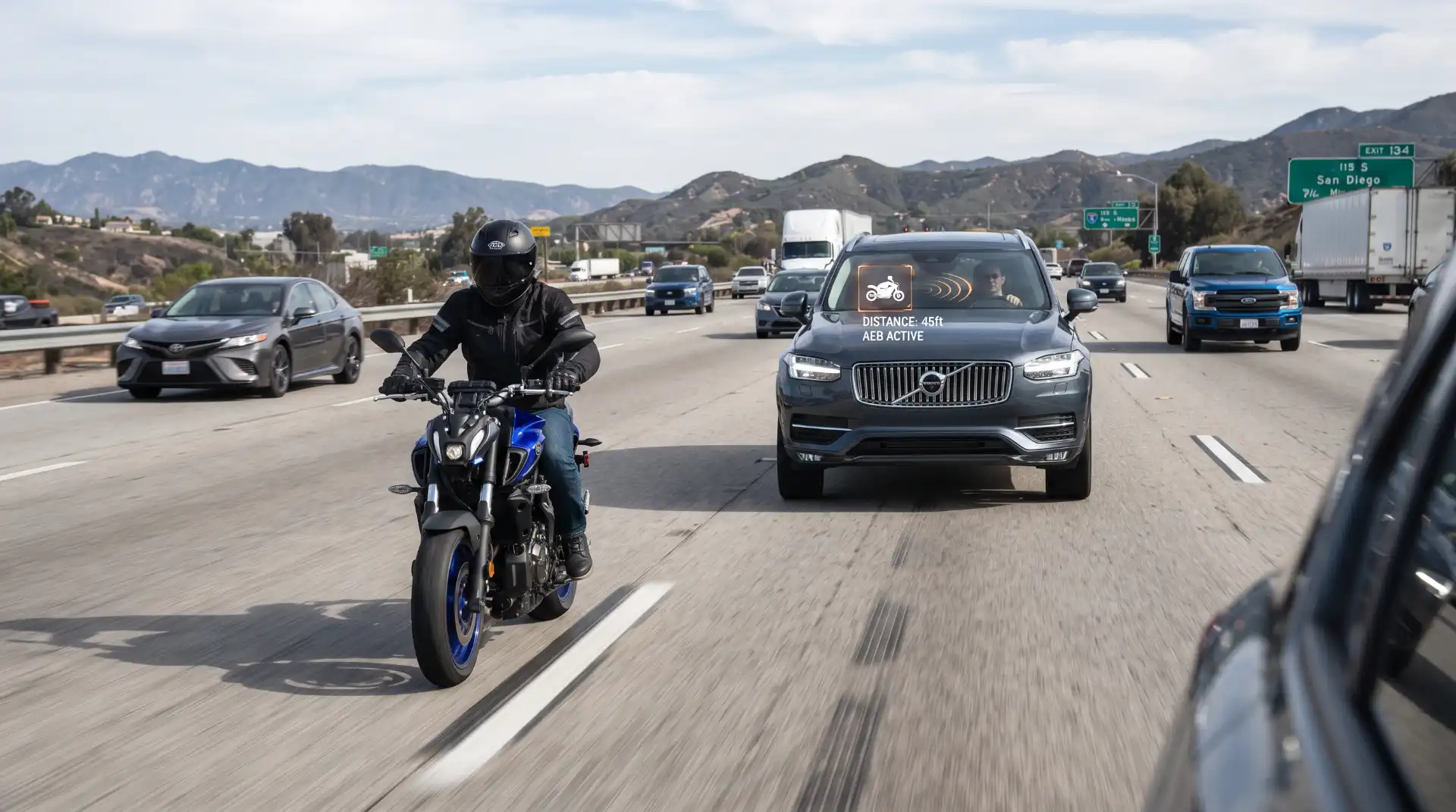
AEB systems usually depend on information gathered by cameras, radar, or both.
Forward-Facing Cameras
A camera mounted near the windshield monitors objects, lane markings, vehicles, pedestrians, cyclists, and other road features.
Software processes the image and attempts to classify what appears ahead. It may recognize a car, truck, pedestrian, bicycle, or motorcycle based on visual patterns learned during development and testing.
The system also evaluates movement. It estimates whether the vehicle is closing the distance quickly enough to create a collision risk.
Camera systems benefit from detailed visual information. However, visibility can affect performance. Darkness, glare, rain, fog, shadows, dirty windshields, and poor contrast may make classification more difficult.
Radar
Radar sends radio waves ahead of the vehicle and analyzes their reflections.
It can estimate the distance and relative speed of objects without relying only on visible light. This ability can make radar especially valuable during changing lighting conditions.
However, object size and geometry affect radar returns. A motorcycle may produce a different signal from a larger passenger vehicle.
Sensor Fusion
Many modern vehicles combine camera and radar information.
The camera can help determine what an object is, while radar helps measure distance and closing speed. Combining both data sources can improve confidence before the vehicle intervenes.
Newer systems may also use increasingly sophisticated software to track several road users simultaneously.
Why Are Motorcycles Harder for AEB Systems to Detect?
Motorcycles create several unique detection challenges.
The most obvious issue is size. Motorcycles have a considerably narrower frontal and rear profile than conventional vehicles.
The rider and motorcycle also create a shape that changes as the rider leans, turns, shifts position, or travels around a curve.
Vehicle systems must determine whether that relatively small object represents a collision threat. They must do this while processing lane markings, surrounding vehicles, signs, shadows, roadside objects, and other information.
A motorcycle positioned directly ahead may be easier to identify than one offset toward the side of the lane.
Distance also matters. At longer ranges, a motorcycle occupies fewer pixels in a camera image. The system may need additional time before confidently classifying the object.
Lane Position Can Affect Motorcycle Detection
Motorcyclists often change their position within a lane for legitimate safety reasons.
A rider may move slightly left to improve visibility around another vehicle. The rider may move right to avoid debris, pavement damage, standing water, or another hazard.
These movements can place the motorcycle away from the centerline that a vehicle’s forward detection system expects to monitor most closely.
IIHS now incorporates motorcycle targets into its vehicle-to-vehicle front crash prevention evaluations. Its current testing includes motorcycles positioned in the center of the lane and offset to either side.
This testing approach recognizes that motorcycles do not always travel directly in front of a vehicle’s centerline.
Can AEB Detect a Motorcycle at Night?
Nighttime detection presents another important issue.
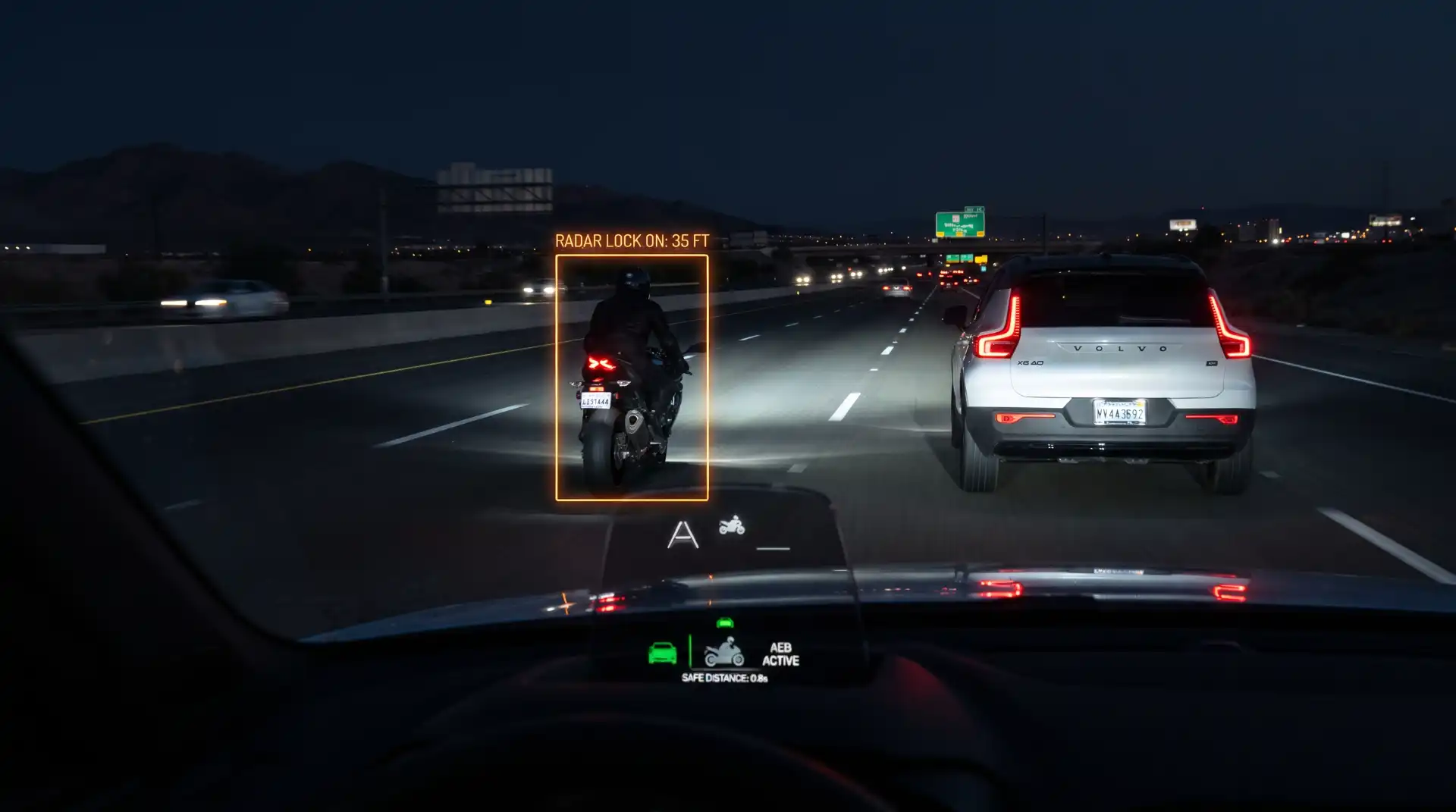
Cameras depend partly on available light and image contrast. Headlights provide illumination, but road geometry, glare, clothing, weather, and background lighting can affect what the camera sees.
A motorcycle may have a smaller illuminated profile than a passenger vehicle. Its taillight configuration can also look different from the broad pair of taillights found on most cars.
Radar can help because it does not depend on visible light in the same way as a camera. Still, actual AEB performance depends on how each manufacturer combines sensor information and software.
Related IIHS research involving bicyclist detection has shown that some AEB systems perform less effectively in certain nighttime scenarios. Researchers found that the systems tested mitigated daytime bicycle crashes more effectively than a scenario involving approaching a bicycle from behind at night with low beams.
Bicycles and motorcycles are different vehicles, so these findings should not be treated as direct motorcycle results. They do illustrate the broader challenge of detecting smaller road users under reduced visibility.
What Happens When a Motorcycle Stops Suddenly?
A stopped motorcycle directly ahead represents one of the situations modern front crash prevention systems may encounter.
The vehicle must identify the motorcycle, calculate the closing speed, determine that a collision risk exists, and decide whether braking is necessary.
If detection occurs early, AEB may slow or stop the approaching vehicle.
If recognition occurs late, the system may reduce the impact speed without completely avoiding contact.
Motorcyclists remain particularly vulnerable in rear-end collisions because they lack the structural protection of an enclosed vehicle.
Even a collision that causes limited damage between two cars can produce serious consequences when one road user is riding a motorcycle.
Does Federal Law Require Automatic Emergency Braking?
Federal AEB requirements are expanding in the United States.
NHTSA finalized Federal Motor Vehicle Safety Standard No. 127 in April 2024. The rule establishes automatic emergency braking requirements for new passenger cars and light trucks.
NHTSA stated that the standard requires qualifying vehicles to stop and avoid contact with a vehicle ahead at speeds up to 62 mph under specified testing conditions. It also establishes automatic braking requirements at higher speeds when a collision becomes imminent.
The agency estimated that the rule could prevent at least 24,000 injuries and save at least 360 lives each year.
The regulation demonstrates the growing role of automated braking in U.S. road safety.
However, the existence of an AEB system does not mean a vehicle can recognize every motorcycle in every condition.
AEB Does Not Replace Driver Attention
Drivers should not treat automatic emergency braking as an autonomous driving system.
AEB is a backup safety feature. It responds to certain collision threats when the system recognizes them.
A driver remains responsible for monitoring traffic, maintaining a reasonable following distance, and responding to motorcycles and other road users.
Drivers should also avoid assuming that the vehicle sees everything they see.
A motorcycle may disappear behind another vehicle, enter a driver’s path from an unusual angle, or travel where an AEB system has limited visibility.
Distraction can make these situations even more dangerous. Motorcycle Crash Attorneys also discusses the risks that distracted drivers create for riders in its article about distracted driving and motorcycle crashes.
Can AEB Prevent Intersection Motorcycle Crashes?
Many AEB systems primarily focus on objects traveling directly ahead.
Intersection crashes can be more complicated.
A motorcycle may approach from the opposite direction while another driver turns left. It might enter from a side street. A motorcycle may also cross the vehicle’s path at an angle.
These situations require the system to identify both the motorcycle and its trajectory.
Research evaluating several passenger vehicle crash avoidance technologies found that front crash prevention had meaningful potential to reduce motorcycle crashes. However, it addressed only a portion of all motorcycle collisions.
Other technologies may play a role in intersection safety as vehicles become more connected.
Future systems could combine AEB with blind spot monitoring, intersection assistance, vehicle-to-vehicle communication, and other technologies.
Are New AEB Tests Becoming More Motorcycle-Focused?
Yes. Motorcycle detection has become a more visible part of vehicle safety testing.
IIHS currently evaluates front crash prevention systems using motorcycle targets, passenger car targets, and large truck scenarios.
The motorcycle portion includes situations where the target sits directly ahead and where it is offset within the lane.
This represents an important shift because testing influences how manufacturers develop and calibrate safety systems.
If vehicles earn better safety evaluations by recognizing motorcycles consistently, manufacturers have a stronger incentive to improve performance around riders.
Could Better Motorcycle Detection Prevent More Crashes?
Research suggests that improvements could prevent additional crashes.
The IIHS study comparing rear-end collisions involving different vehicle types found weaker front crash prevention results when a motorcycle or large truck was struck.
Researchers estimated that more than 500 additional motorcycle rear-end crashes could potentially be prevented each year if systems performed as effectively around motorcycles as they did around passenger vehicles.
Earlier IIHS research also examined the broader potential of crash avoidance technology.
That research concluded that improving passenger vehicle systems so they better recognize motorcycles could prevent or mitigate thousands of two-vehicle crashes involving riders.
The findings support continued development of motorcycle-specific detection and testing.
What Conditions May Affect AEB Motorcycle Detection?
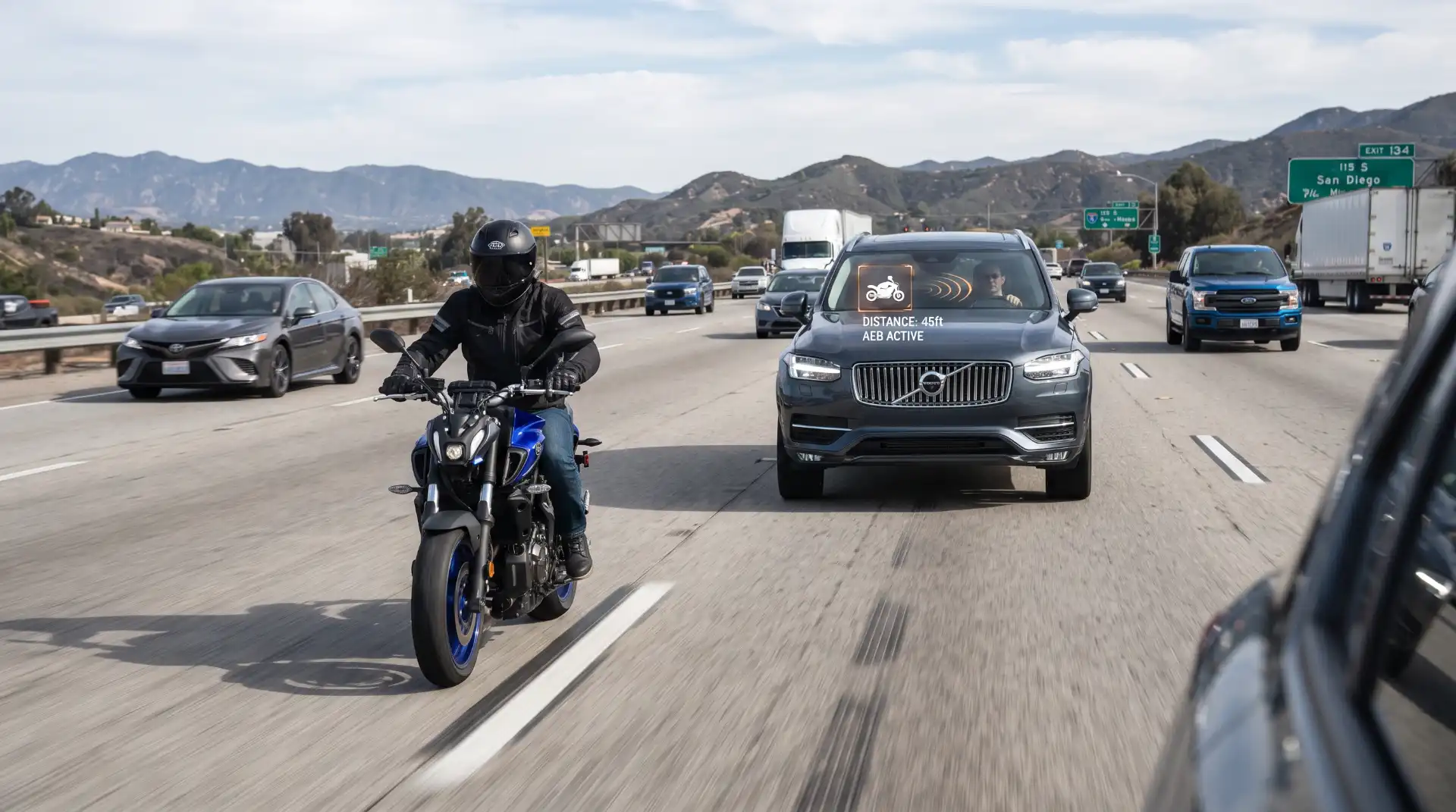
No single factor determines whether an AEB system recognizes a motorcycle.
Several conditions may affect performance simultaneously.
Poor visibility can reduce the quality of camera information. Heavy rain, fog, snow, darkness, glare, or direct sunlight may interfere with detection.
Road curvature may also affect what forward sensors see. A motorcycle traveling around a bend may enter the detection area later than a vehicle traveling on a straight road.
Motorcycle orientation matters as well. A bike viewed directly from behind presents a different sensor profile from one viewed at an angle.
Sensor condition can also matter. Dirt, ice, snow, physical damage, windshield replacement, or improper calibration may affect some advanced driver assistance systems.
Motorcycle Crash Attorneys has additional information about environmental factors in its article on weather and lighting conditions in motorcycle crashes.
What Evidence May Matter After a Crash Involving AEB?
A collision involving an AEB-equipped vehicle may create questions that did not exist with older vehicles.
Investigators may need to determine whether the vehicle detected the motorcycle before impact.
They may also examine whether the system issued a warning, whether automatic braking activated, and whether the driver applied the brakes independently.
Depending on the vehicle and circumstances, relevant evidence may include event data recorder information, diagnostic records, camera footage, system fault codes, repair history, photographs, and vehicle inspection results.
Dashcam recordings and surveillance video can also help reconstruct the motorcycle’s position and the vehicle’s movement before impact.
Physical evidence remains important. Skid marks, impact points, motorcycle damage, vehicle damage, debris patterns, and final resting positions may help investigators understand the sequence of events.
Motorcycle crash investigations increasingly involve both traditional physical evidence and electronic information.
Does AEB Failure Automatically Mean the Manufacturer Is Responsible?
No. A crash involving an AEB-equipped vehicle does not automatically establish that the system failed or that a manufacturer bears responsibility.
AEB systems operate within defined conditions and limitations.
A collision may involve driver behavior, excessive speed, limited visibility, road design, environmental conditions, another vehicle’s movement, or several factors together.
Determining why a collision occurred may require examining the specific vehicle, the manufacturer’s system documentation, available electronic data, and the crash circumstances.
A malfunction is different from a system operating within its documented limitations.
That distinction can become significant when evaluating crashes involving advanced vehicle technology.
Motorcycle ABS and Car AEB Are Different Technologies
Automatic emergency braking on a passenger vehicle should not be confused with antilock braking systems on motorcycles.
Passenger vehicle AEB tries to detect a potential collision and apply the vehicle’s brakes.
Motorcycle ABS helps prevent a motorcycle’s wheels from locking when the rider brakes hard.
Both technologies relate to braking, but they serve different functions.
IIHS reports that motorcycles equipped with optional ABS have a 22 percent lower fatal crash involvement rate than comparable versions without ABS.
Modern motorcycle safety may increasingly involve several layers of technology. These include ABS on the motorcycle and improved detection systems on surrounding vehicles.
Can Riders Do Anything to Improve Their Visibility to AEB Systems?
Riders should not depend on another vehicle’s AEB system to recognize them.
The most useful approach remains riding as though nearby drivers and automated systems may not detect the motorcycle immediately.
Maintaining space from surrounding vehicles can create additional reaction time.
A predictable lane position may also help other drivers understand a rider’s movement. However, riders may still need to change lane position to avoid hazards or maintain visibility.
Functional headlights, taillights, brake lights, and turn signals also remain important for visibility.
Technology can provide another layer of protection, but it cannot eliminate the basic vulnerability associated with riding a motorcycle around larger vehicles.
What Does the Future of AEB Mean for Motorcyclists?
Motorcycle recognition is becoming a more significant part of vehicle safety development.
Federal AEB requirements, stronger consumer testing, improved cameras, higher-resolution radar, and better object-classification software can encourage further progress.
The introduction of motorcycle targets into front crash prevention evaluations is particularly meaningful.
Manufacturers now face clearer expectations that systems should recognize more than conventional passenger cars.
Future vehicles may also share information directly with motorcycles through connected vehicle technology. A motorcycle could theoretically alert nearby vehicles to its position even when another object blocks direct sensor visibility.
These developments may expand the role technology plays in preventing crashes.
However, automated systems still operate within technical limits. Driver awareness remains essential.
The Bottom Line
Automatic emergency braking can detect motorcycles and may prevent or reduce the severity of some crashes. Current research shows measurable benefits, particularly in rear-end collision scenarios.
However, motorcycle detection remains more challenging than detecting another passenger vehicle. A motorcycle’s smaller profile, lane position, lighting, road geometry, weather, speed, and sensor limitations can all affect system performance.
IIHS research found that front crash prevention reduced rear-end crashes involving motorcycles, but the reduction remained lower than for crashes involving passenger cars. That gap shows why motorcycle-specific testing and further technology development remain important.
As AEB becomes more common on American roads, riders may benefit from improved vehicle detection. They should still assume that drivers and automated systems might not see them in every situation.
Motorcyclists interested in related crash topics can also explore the site’s motorcycle accident resources, including information about intersection accidents, road hazards, distracted driving, defective equipment, and insurance disputes.